Business
Scaling is not climbing faster
I saw myself as a mountain climber.
More altitude. More pace. More effort. If the company wasn't growing, it was because I wasn't climbing fast enough.
I had been following Daniel Marcos on YouTube long before that. Clips, meetings, Scaling Up. The kind of content you watch on your phone and go "yes, of course"… and the next day you're still the rope.
The real shift wasn't a video. It was a year before taking Bolteam to Mexico's most famous Tanque de Tiburones. I had already studied it. The problem was I hadn't been able to execute it.
You just need that spark. That MOTIVATOR. To push and say enough. Because growing in disorder is a roller coaster. And sometimes the car only goes down. And you don't know what to do.
That's when I started APPLYING it. Installing it with my teams. Communication. Handoffs. Rhythms. Chairs.
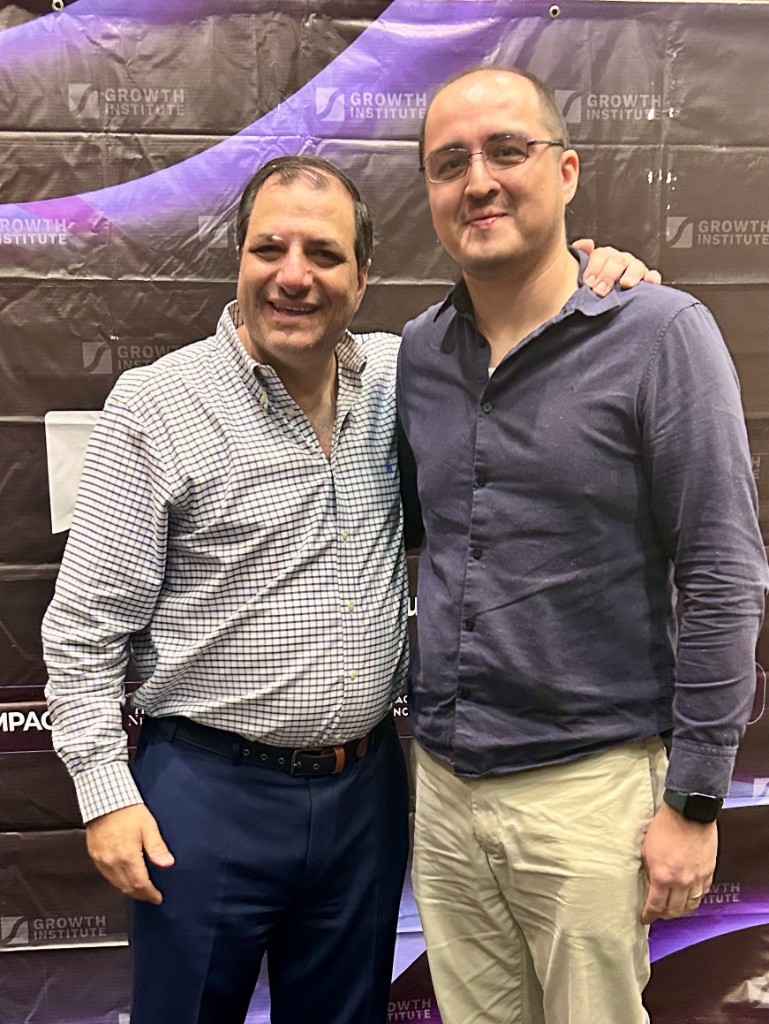
March 26, 2025 was not the beginning. It was the day I saw him live. I went to an event. And yes: I took the photo.
The map does not climb the mountain
Daniel — Growth Institute, Scaling Up on this side of the world — did not sell me a miracle the day I saw him. I already had the map.
And the map said something a founder hates to read: a company does not stay small because the owner doesn't work. It stays STUCK because the owner is the only one who knows how to climb.
More times than I'd like to admit, I was the rope, the anchor, and the guy yelling "follow me!" at the same time.
The strangest part of the story is Bolteam. It started as an advertising agency. And this is what happened: I BROKE the company by trying to drag it myself. No systems. No structure to scale. No base camp that could hold if I let go of the rope.
(Spoiler: that does not scale. That just wears you out. And sometimes, it cracks the business.)
Scaling Up — Verne Harnish's system, the one Daniel runs with iron discipline — pushed me to see the company as a system. And, above all, to understand that what MOVES a company is its people… and a system behind them that makes growth possible.
My partner Adrián Garza, from GAMBI, had been saying it all along. He's a wise old operator. A born entrepreneur, with more scars and scratches than I have.
I'm a bit hard-headed. I had to LIVE it before I listened.
Why a company gets stuck
There's a very specific moment when you stop growing and don't notice. Sales keep coming. The team is "busy." You're in every meeting. And still, if you get sick on a Friday, on Monday nobody knows what to do.
That is not a motivation problem. That is a SYSTEM problem.
What stuck with me — and what I was later able to install for real — fits in four boring things that are worth more than any "vision" offsite:
- How the team communicates when you're not in the WhatsApp group
- How work gets handed from one area to another. The HANDOFF. The one everybody swears they do and almost nobody does
- Meeting rhythms. The PARTNER ones. Not more meetings. The ones that start putting the CHAOS in order. With a date. With a decision
- Who is sitting in each chair. Culture is not pizza on Fridays. Culture is what you tolerate when someone delivers half a job
If any of those four breaks, the company stays on the same wall. You can hire more people. You can buy more software. You can work Saturday. You're still on the same wall.
Communication is not "staying on top of it"
For years I confused communication with availability. I replied fast. I was in every thread. I knew everything.
That is not communication. That is a bottleneck with WiFi.
A company scales when information does not live in the founder's head. It lives in a process: who tells whom, with what, before which date. If the only way you find out a customer got angry is being in the chat yourself, you don't have operations. You have an expensive WhatsApp group.
The handoff is where the money falls
The handoff is the moment sales passes the customer to operations. Or product passes a feature to support. Or collections passes a case to somebody else.
That's where context dies. That's where "I thought you…" kills more deals than the competition.
A good handoff is not an email that says "here you go." It's a delivery with an owner, with what was already promised, with what's missing, and with the next date. If it doesn't fit in a half-page note, it isn't ready to be passed.
I learned this the hard way. (💩 shit happens.) Every time a customer felt abandoned between one area and another, the problem wasn't "the team." The problem was that nobody had defined the moment the baton changes hands.
Rhythms, not heroics
Scaling Up insists on rhythms: daily, weekly, monthly, quarterly. It sounds like a corporate calendar. It isn't.
It's the difference between a team that aligns and a team that finds out by accident.
With no rhythm, meetings become theater: everybody talks, nobody decides, and you leave with more tasks than you walked in with. The rhythm that changed the game for me didn't start in the teams. It started in the partner meetings. Sit down. Put the chaos in order. Decide.
And yes: it hurts at first. Because it forces you to stop being the hero who "already knows everything."
The right people (and the culture that isn't a poster)
You can have the prettiest map in the world. If the wrong people are in the wrong chairs, the map does not get walked.
A real organizational culture shows up in two places: what you reward and what you let slide. If you let a sloppy handoff slide because "they're a good person," you're training the team to deliver sloppy. If you're the only one who can make a hard call, you don't have leaders. You have helpers.
The right people are not the brightest. They're the ones who can play the system: they communicate, they deliver, they ask for help on time, and they don't need the founder to remind them of the obvious every Monday.
Daniel's push. Ryan's system.
Here's the part that changed my operation, not just my head.
Daniel Marcos, with Scaling Up, has a different system. More frame. More map. More "this is what a company that actually scales looks like." That map was the MOTIVATOR. It made it impossible to keep pretending that climbing faster was the strategy.
But a map does not install base camp.
That push took me to Ryan Deiss's methodology — the Scalable Operating System — which is more practical, more direct, more "we install this this week across a system of companies." Less mountain theory. More: which meeting, which scoreboard, which task leaves the founder's head and stays with the team.
It's not that one is "better" than the other. One showed me why we were stuck. The other gave me the process to stop being stuck.
And in companies that already bill and already have people, that is not a luxury. That's what RAISES THE VALUE. A company is worth more when you are not the rope. When a partner, a team, or next Monday can understand how the business runs without texting you at 11 p.m.
💡 The question I ask myself every quarter
Where in your companies are you still the rope?
Communication? The handoff? The meetings? The chairs?
Write me at hola@jorgenajera.com or on LinkedIn. Tell me your story. It's always a pleasure to talk with a founder or operator who is trying to scale.
If you're at that point where the business is growing and so are you, but you're not sleeping, let's talk. Most of the time the problem isn't the market. It's base camp.